Ancient Egyptian Pulp Mummy Mask

Ancient Egyptian Pulp Mummy Mask

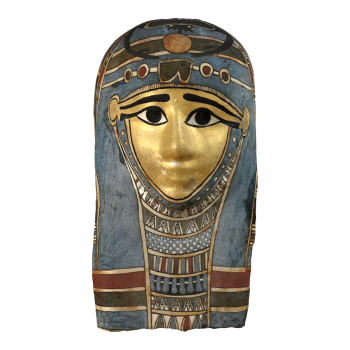
This artifact is a complete pulp mask, including the mask and three chest patches. It was excavated by the Egyptian Exploration Society in Abidos. This ancient Egyptian artifact can be traced back to the Ptolemaic period between 323-30 BC. The golden color reflects the ancient Egyptians' belief that the skin of gods was made of that material. This artifact is currently located at the National Museum of Scotland.
Pink granite statue of Ankhkirednefer in ancient Egypt

Pink granite statue of Ankhkirednefer in ancient Egypt

This statue has a beetle on its head, the symbol of Osorkon II engraved on its arm, and the image of Osiris inside the shrine. The edge of the shrine and the back pillar of the spire are both engraved with hieroglyphs. This statue was discovered in Ter Mashuta, Egypt, and is 62 centimeters high, 28 centimeters wide, and 38 centimeters long. It is now housed in the British Museum. Ankhkirednefer served as the Grand Inspector of the Palace and an excellent secretary of the Temple of Artum under the rule of Osorkon II, the fifth king of the 22nd Dynasty of Egypt.
The human shaped coffin lid of the ancient Egyptian mummy Irthorru

The human shaped coffin lid of the ancient Egyptian mummy Irthorru

This wooden humanoid coffin lid comes from the ancient Egyptian mummy Irthorru, who was a priest of the Min and other divine sects of Akhmim's family. This coffin lid is 26 centimeters high, 183.50 centimeters long, and 54.50 centimeters wide. The inscription on the coffin lid includes the title of 'Priest of Min'. This coffin lid is housed in the British Museum but has not been exhibited in any exhibitions.
Part of the Head Statue of Pharaoh Amenhotep III in Ancient Egypt

Part of the Head Statue of Pharaoh Amenhotep III in Ancient Egypt

This sculpture is carved from red granite and has a height of 63.50 centimeters. This statue can be traced back to approximately 1370 BC and was discovered within the walls of the Muth Temple in Karnak, ancient Egypt. This huge statue has been broken, and currently known parts include a head and an arm. Both of these parts are now at the British Museum.
Granodiorite statues from the 26th Dynasty of ancient Egypt
Granodiorite statues from the 26th Dynasty of ancient Egypt

This statue is a kneeling statue made of granite from the 26th Dynasty, and it is the image of Mentuemhat. The stone tablet on the statue depicts a scene of worship, with eleven rows of pictographic characters on it and two columns of pictographic characters on the back pillar. Mentuemhat was a wealthy and powerful official during the 25th and 26th dynasties of ancient Egypt. He was the mayor of Thebes and the fourth priest of the god Amun. This statue may have originated from Mentuemhat's tomb in Assassif, Thebes. This statue is currently located in the British Museum.
Ancient Egyptian Lion Sculpture

Ancient Egyptian Lion Sculpture

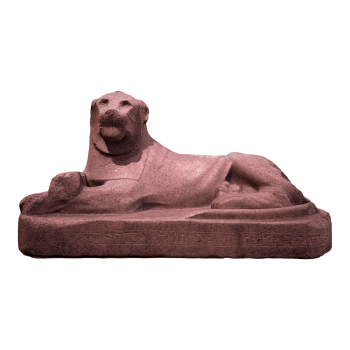
This is one of a pair of lions. The sculpture is carved from red granite, with each lion measuring approximately 1.20 meters in height and 2.20 meters in length. The sculpture is from the Sulib Temple in Nubia, which was built by King Amenhotep III of the 18th Dynasty. Later in the third century AD, it was transferred to Gebel Barkal in Sudan by King Amanislo of the Meroe Kingdom. In the early 19th century, Lord Prudhoe took the lions from Gebel Barkal and handed them over to the British Museum in 1835.
Ancient Egyptian Scarab Sculpture

Ancient Egyptian Scarab Sculpture
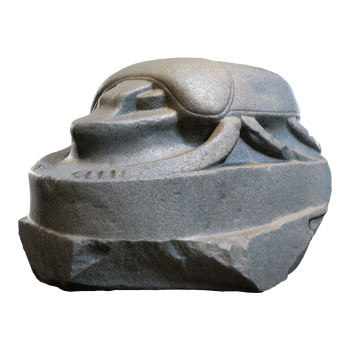
The Scarabeus sacer is a lasting symbol of ancient Egypt, representing rebirth and associated with the rising sun. This beetle lays eggs by rolling dung balls, a behavior believed by ancient Egyptians to be similar to the process of the sun rolling from the east across the sky to the west. This sculpture is carved from green diorite and measures approximately 1.5 meters in length, making it one of the largest known beetle figures.
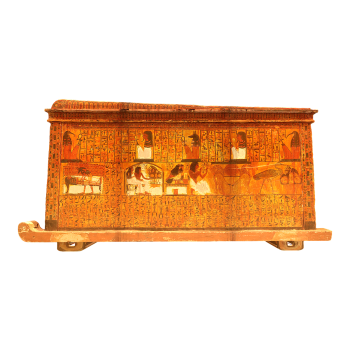
One of the coffins of Senechem in ancient Egypt
One of the coffins of Senechem in ancient Egypt

Senechem was a bricklayer who lived during the 19th Dynasty of ancient Egypt. In 1886, this coffin was discovered in the tomb of Deir al Medina in Egypt. It is housed in the Egyptian Museum.
Anubis Shrine in the Tomb of Ancient Egyptian Pharaoh Tutankhamun
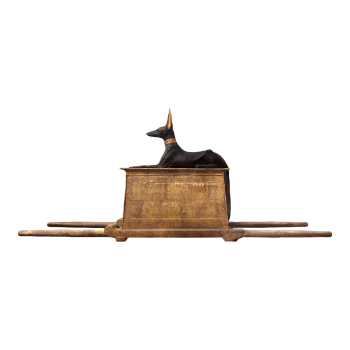
Anubis Shrine in the Tomb of Ancient Egyptian Pharaoh Tutankhamun

The artifact is a gilded wooden shrine with a reclining statue of Anubis placed on top. This shrine was found in the "treasury" room of the tomb of Egyptian pharaoh Tutankhamun. The treasury room is a place in Tutankhamun's tomb used to store treasures and treasures. The shrine consists of two parts, with an insertable Anubis statue at the top and an independent storage room with a sliding cover at the bottom. The sliding cover can be opened to expose the internal compartments. The front part of the compartment is divided into four smaller compartments. At present, this cultural relic is housed in the Egyptian Museum.
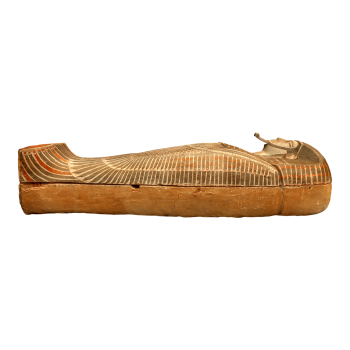
The wooden coffin of Pharaoh Kamosis in ancient Egypt

The wooden coffin of Pharaoh Kamosis in ancient Egypt

Kamosis was a pharaoh of the 17th Dynasty of ancient Egypt, who inherited the war initiated by his predecessor, Seqenenra Taa, to expel the kings of the Hyksos dynasty. The wooden coffin of Kamosis is currently on display at the Egyptian Museum in Cairo. This is one of the most important collections of ancient Egyptian art and artifacts in the world.
Coffin of Pharaoh Ramses II of ancient Egypt
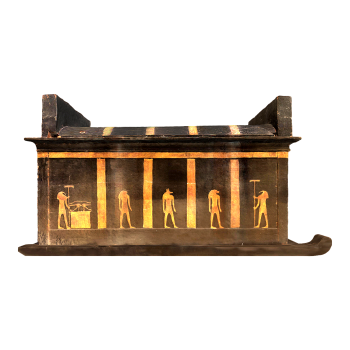
Coffin of Pharaoh Ramses II of ancient Egypt

Ramses II was a pharaoh of the 19th Dynasty of ancient Egypt, who ruled from 1279 BC to 1213 BC. This coffin was found in Tomb DB320 of the Royal Mummy Library, where the remains of Ramses II's mummy were discovered. Now this coffin is hidden in the Egyptian Museum.
Wooden coffin of ancient Egyptian nobleman Yuya
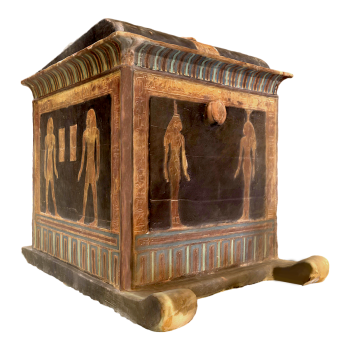
Wooden coffin of ancient Egyptian nobleman Yuya

Yuya was a powerful aristocrat in the 18th Dynasty of ancient Egypt. This coffin is rectangular, with a flat top and protruding structures at both ends. The coffin is dark brown with golden inscriptions and illustrations on it. The coffin is evenly distributed with vertical golden stripes along its length. The coffin depicts the image of characters, possibly representing gods or important individuals, painted in traditional Egyptian art style with golden pigments. This coffin is currently at the Egyptian Museum.
The Canopus Box of Yua in Tomb KV46, Egypt

The Canopus Box of Yua in Tomb KV46, Egypt

Yua was an important figure of the New Kingdom period (15th century BC), the father-in-law of the ancient Egyptian pharaoh Thutmose III (Tutmosis III) and the father of the Egyptian queen Tiye. Yua's canopus box preserves Yua's internal organs, including lungs, stomach, liver and kidneys. In ancient Egyptian burial rituals, the organs were placed in four separate canopus boxes for use in the afterlife. Yuya's Canopus box, currently in the Luxor Museum, is a valuable work of art and archaeological artifact, representing the exquisite craftsmanship and cultural traditions of the high Egyptian society of the time.
Hannifer granite sarcophagus during the reign of Ramses II in 1225 BC
Hannifer granite sarcophagus during the reign of Ramses II in 1225 BC

This sarcophagus is a granite sarcophagus from the reign of Ramses II in 1225 BC. It was found in Hannifer, Egypt, hence the name Hannifer sarcophagus. This sarcophagus is carved from a huge granite monomer. Its dimensions are very large, measuring about 3.7 meters (12 feet) long and weighing about 120 tons. The inside of the sarcophagus was originally empty and no body was found. However, its design and decoration suggest that it was once a funeral vessel for an important person. The exterior of the sarcophagus is decorated with fine reliefs depicting religious and mythological scenes of ancient Egypt. It was given to the Fitzwilliam Museum in Cambridge, England in 1835.
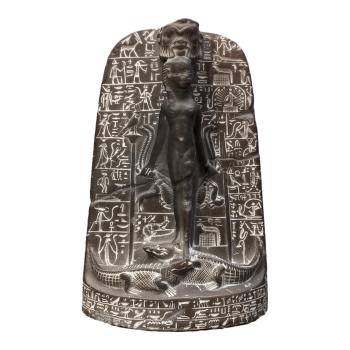
Ancient Egyptian cylinder of black soft stone in the British Museum

Ancient Egyptian cylinder of black soft stone in the British Museum

It is a small stone artwork, usually cylindrical or nearly cylindrical. Its surface is smooth and its color is black. This stony material is called soft stone because it is relatively easy to carve and process. These columns are often used as monuments, altars, or as carriers of spells. They played an important role in ancient Egyptian religion and religious rituals. They are often placed in temples, cemeteries or other important religious sites.